


From navigating complex global regulations to reducing waste and transforming customer pickup experiences, modern retail and CPG organizations are putting AI and generative AI to work in practical, high-impact ways.
These real-world use cases, supplemented with findings from IBM’s Institute for Business Value, highlight how companies across consumer products and retail are using AI to improve compliance, optimize operations, empower employees, and differentiate their brands while building trust through responsible AI practices.

Using AI to Streamline Regulatory Management Across Regions
A multibillion-dollar global consumer products company operates in the highly regulated agricultural products industry. It devotes significant resources to managing compliance with local regulations, staying current with continuously changing guidelines, and integrating compliance into the product development process.
To help its product compliance and development teams reduce heavy manual workloads and free up more time to work strategically, the company worked with IBM to develop a generative AI-powered regulations assistant. This solution features a conversational user interface and provides a single source of truth for over 1,000 regulations impacting worldwide operations.
The regulations assistant enables product compliance employees to predict the impact of regulatory intent, summarize regulatory requirements, and compare regulations globally, faster than with manual processes.
The AI tool also enables product developers to analyze the impact of regulations on product portfolios, review solution options, and query product specifications in a conversational journey.
To date, the regulations assistant has demonstrated that generative AI can orchestrate regulations data quickly and drive closer collaboration across borders to leverage regulatory success across the business.
The tool also has the potential to increase efficiency by 8% to 13%, increase productivity by 10% to 15%, and increase profits by over $165 million during the next five years.
A Japanese Retailer Empowers People with AI to Boost Profits While Reducing Waste
A leading retail company in Japan was grappling with a costly problem: food and consumer-goods waste was eating away at their profits.
The client’s field staff needed data-driven insights to make more informed pricing decisions. For a wide variety of products and the company’s operations, price optimization relied more heavily on human judgment than data, leading to variations in customer forecasts, stock levels, and discount rates.
These variations resulted in excessive and inadequate stocking, irregular discount amounts and timings, and large profit losses due to food waste and missed sales opportunities. The company worked with IBM to develop a specialized price optimization AI system to analyze vast amounts of data, predict customer numbers and purchase patterns, and suggest optimal discount amounts and timings.
Now the client’s field staff can combine their own expertise with data to improve pricing decisions. The pricing optimization system was designed to adapt to different product categories and sell-by durations, making it a versatile, scalable solution that can support a diverse product range.
Kroger Uses AI to Elevate Customer Pickup Experiences
Kroger has long depended on data and advanced analytics to fuel business innovation. Since its inception decades ago, its loyalty program has delivered a trusted value exchange enabled by permission-based information.
Today, using machine learning algorithms, Kroger delivers valuable personalized offers and communications across 150 million customer touchpoints and through 1.9 billion unique coupons customized for millions of loyal customers. Most recently, Kroger has been exploring ways to use AI to help improve the customer experience, specifically order pickups.
Using AI-enabled dynamic batching, an AI solution sorts through 200,000 totes per second to build the most efficient pickup trolley. It drives a 10% reduction in steps by identifying the most efficient pick route through the store.
With dynamic batching of orders, these tools are providing associates the most efficient pick routes, so Kroger can dramatically reduce pickup lead time in its highest volume stores.
Modern Retail and CPG Organizations Plan to Use AI Extensively in 2025
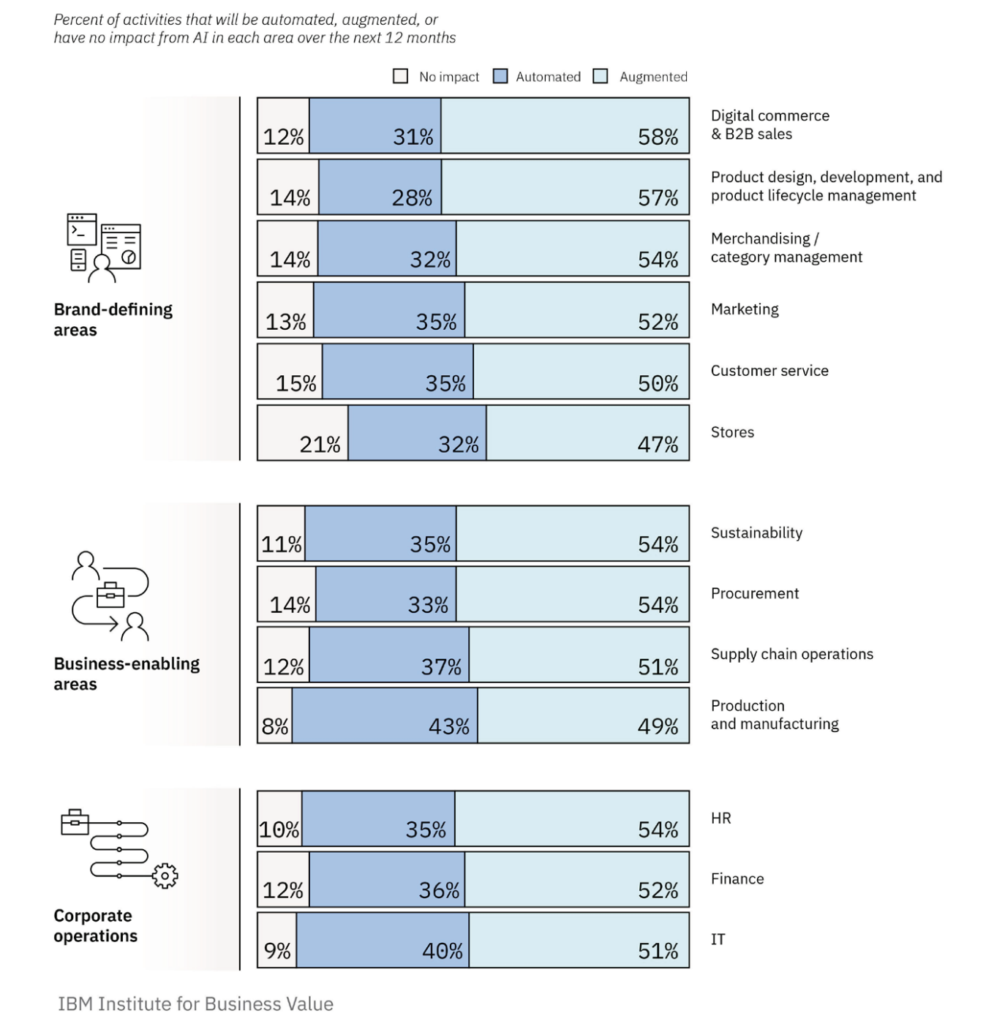
How to Make AI a Brand Differentiator
Customer-obsessed businesses need to deliver on what their written policies dictate for responsible AI practices. Build confidence in responsible internal uses of AI before expanding to customer-facing use cases where broken trust can damage your brand.
Purge bias from your algorithms. To provide transparency and explainability, define clear guidelines to monitor for discriminatory patterns. For example, conduct regular audits on historical purchasing and customer data that may reflect stereotyping and societal biases. Facilitate human-AI collaboration and oversight with training that helps employees understand and recognize fairness and bias. Prioritize diversity on your AI development teams.
Establish a data governance framework to support data provenance, helping ensure your data is authentic and trustworthy. Maintain detailed records of bias mitigation efforts, create dedicated channels for bias-related feedback, and regularly incorporate insights into system improvements.
Leverage AI to proactively navigate regulations. To stay ahead of an AI regulatory environment that is evolving at varying paces globally, use AI solutions to capture regulatory intent across multiple channels and forecast its impact. Choose AI development tools that build in governance and regulatory compliance management end to end.Proactively compare old and new regulations to quickly identify key focus areas within impact assessments. Automate tools to stay up-to-date and streamline audit processes.
Be open about your use of AI with customers and partners. Build trust with customers by being up-front about data collection as well as how and where you are using AI. Offer opt-out options and avoid tech-speak in your explanations. Exchange AI roadmaps and strategies with business partners. Demonstrate your commitment to responsible AI practices and request the same of your partners.
Looking to take a deeper dive into the state of AI in the retail and CPG space? Check out key AI trends and takeaways from our recent Retail & CPG Summit.
You can also find us at NRF 2026 to continue the conversation, or talk to one of our experts today.