


Everyone wants to talk about agents right now. Agentic this, multi-agent that. And most of the people asking me how to get there are on the first rung trying to jump straight to the fifth. It does not work, and the reason it does not work is that each rung is built out of the one below it. You cannot skip the middle and land on top.
So here is the maturity model I use to figure out where someone actually is, and what their single next move should be.
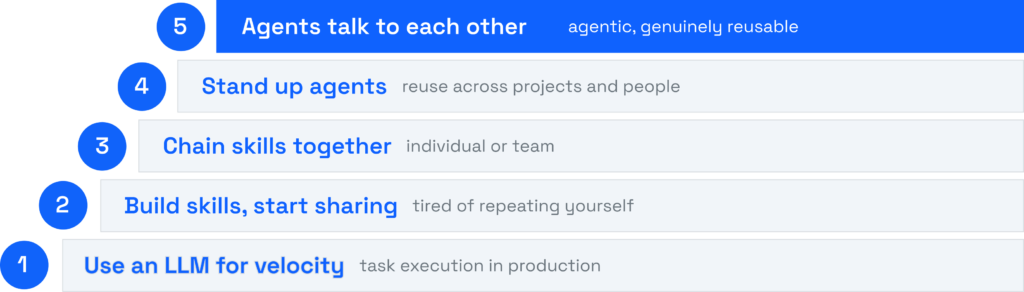
The Five Rungs
One: use an LLM for velocity.
You are using a model to go faster on real work in production. Task execution, nothing more. This is where almost everyone starts, and it is a perfectly good place to be. Most of the value most people will ever get from AI lives on this rung.
Two: build skills, start sharing.
You get tired of retyping the same prompt, so you capture it as a named, reusable set of steps. Then you share it with someone else. Notice the trigger here is annoyance. That is feedback doing its job, pushing you up.
Three: chain skills together.
You or your team start composing skills into longer workflows, where the output of one becomes the input to the next.
Four: stand up agents.
You realize the skills can be reused across projects and by other people, so you stand up one or more agents to carry them. The work stops being yours and starts being infrastructure.
Five: agents talk to each other.
Agents are configured to hand off to one another for a specific workflow. This is the agentic rung, and it is where the work becomes genuinely reusable rather than a clever thing you built once.
The Ladder Is Itself A System
Worth naming, because it tells you how to climb: this model is a system, and it obeys the same rules every system does.
Each stage builds on the prior one. That is interdependence, and it is exactly why you cannot skip rungs. The capability at stage five is emergent, no single stage below it contains it, it only appears when the pieces connect. And the thing that drives you up the ladder is feedback, specifically the pain of repeating yourself. You do not climb because a blog post told you to. You climb because rung N got annoying enough to make rung N-plus-one worth the effort.
That is the healthy way to move. Let the friction tell you when you are ready.
What the Top Rung Actually Looks Like
The fifth rung sounds abstract until you put a real workflow on it. Take a migration workflow for example, shim bronze, migrate pipelines, orchestrate, deploy, validate, and run it as an agentic workflow.

Each step becomes an agent that hands off to the next. Each agent executes skills. The validation agent feeds its findings back to the steps that can act on them. The mapping is clean: roles become agents, the method becomes the workflow, the procedures become skills. The eight-step delta procedure that used to live in my head is now just a skill the pipeline-migration agent runs.
And here is the payoff. The workflow produces a completed, validated migration that no single agent or skill did on its own. The whole is genuinely greater than the sum of the parts. That is not a buzzword, that is the literal definition of an agentic system working.
How to Tell You Are on the Wrong Rung
The fastest way to get burned is not staying on a low rung, it is jumping to a high one before the rungs underneath it exist. That failure is easy to spot once you know the symptoms, so here is what to look for.

The most common tell: you stood up agents, but you cannot explain why the workflow produced what it did. That almost always means you skipped the skill-building and chaining rungs. You are orchestrating steps you never validated, so when the output is wrong, you have nothing to inspect and nowhere to start.
A close cousin: your “agentic” workflow needs constant babysitting. If you are watching every run and catching problems by hand, it is not reusable yet. It is a demo in a costume, and you are still doing rung-one work while telling yourself you are on rung five.
The quieter failure runs the other direction. You retype the same prompt five times a day and have never captured it as a skill. That friction is feedback, and it is telling you to climb. Ignoring it is its own kind of stuck, you are leaving the easiest gains on the table.
The pattern underneath all of these is the same. The rung you are actually on is defined by what you can inspect and reuse, not by the most advanced thing you have managed to run once. If you cannot trace a result back to a specific skill, boundary, or feedback step, you have built higher than your foundation supports, and the fix is to climb back down and build the rung you skipped.

Find Your Rung
The move is not to jump to stage five. The move is to find the rung you are actually standing on and take one step up from it.
If you are at stage one, your next move is a single skill, not an agent swarm. If you are at stage three with a pile of chained skills, maybe it is time to stand up an agent. Skipping rungs is how you end up with a runaway agentic workflow you do not understand, built on skills you never validated, debugging a system you never actually built.
Find your rung. Take the one next step. That is the whole strategy.
If you’re looking to find your place on the AI maturity curve, turn individual AI velocity into reusable team capabilities, or accelerate your agentic AI strategy, Hakkoda and IBM can help. Contact our team to start the conversation today.
The techniques that carry you up the first four rungs, predefining context, building utilities, and closing feedback loops, all come from treating your AI like a system. I have written at length about that foundation in in The Systems Thinking Approach to Reliable AI.