

Today’s large language models, whether you’re using Claude, GPT, Mistral, or another leading model, are remarkably good at reasoning. They can summarize documents, generate code, answer complex questions, and solve sophisticated problems.
What they can’t do on their own is interact with the systems where your business actually operates. An LLM can’t check your Jira backlog. It can’t retrieve files from GitHub. It can’t create a table in Snowflake or post an update in Slack unless someone gives it a way to do so.
That’s why so many enterprise AI initiatives stall after the proof of concept. The model is capable, but it’s isolated from the tools and data that make it useful.
To bridge that gap, organizations have traditionally built custom integrations between every AI model and every enterprise application. One connector for Jira. Another for GitHub. Another for Snowflake. Another for Slack. Then repeat the process for every AI assistant you want to support.
The math gets ugly quickly. Five AI models connected to five enterprise systems means twenty-five separate integrations to build, secure, and maintain. As organizations adopt more AI models and more business applications, that complexity only continues to grow.
This is the classic N × M integration problem, and it doesn’t scale.
Enter MCP: A Universal Communication Hub for Enterprise AI
Fortunately, that is exactly the challenge the Model Context Protocol (MCP) was created to solve.
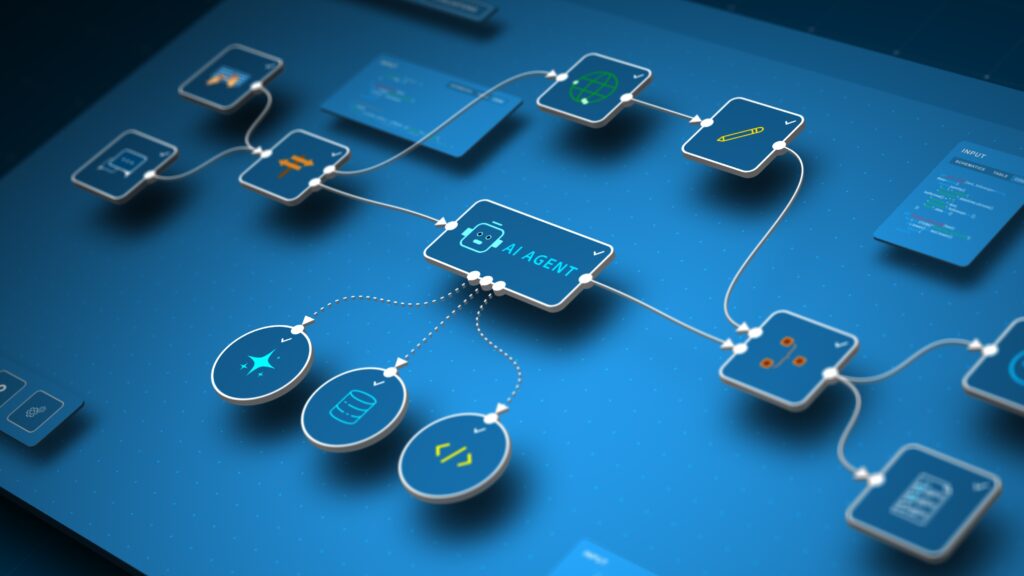
MCP is an open standard that gives AI assistants a universal way to communicate with external systems, whether that’s a database, an API, a file system, or enterprise applications like Jira, GitHub, or Snowflake. Instead of every model requiring its own custom connector, systems expose capabilities through a common interface that any MCP-compatible AI can understand.
Google Cloud compares it to USB-C, and it’s an apt analogy. Before USB-C, every device came with its own charging cable. Today, one connector works across laptops, phones, monitors, and countless peripherals. MCP brings that same standardization to enterprise AI, allowing organizations to build integrations once instead of rebuilding them for every new model.
The result is simpler architecture, less maintenance, and AI workflows that are far easier to extend as new tools and models emerge.
How MCP Works
Behind the scenes, MCP follows a straightforward architecture built around four components.
The host is the application where users interact with the AI, whether that’s Snowflake CoCo, Cursor, Claude Desktop, IBM Bob, or another AI environment.
Within the host sits an MCP client, which manages communication with one or more MCP servers.
Each MCP server exposes capabilities from a specific business system—GitHub, Jira, Snowflake, Slack, or an internal application—and translates AI requests into actions those systems understand.
Finally, the server exposes tools, along with optional resources and prompts, that the AI can invoke during a workflow.
The result is an architecture where new enterprise systems become reusable building blocks instead of one-off integrations.
Intelligence Alone Isn’t Enough
Giving an AI assistant access to enterprise tools is only part of the equation.
Without guidance, even a highly capable model can make unpredictable decisions. It may execute tasks in the wrong order, skip validation steps, overlook documentation, or perform actions before prerequisite checks have been completed.
For enterprise workflows—especially those involving production systems—that level of improvisation introduces unacceptable risk.
What organizations need is deterministic behavior: the ability for AI agents to follow the same sequence of validated steps every time.
Deterministic Agentic Workflows
This is where MCP becomes significantly more powerful when paired with workflow definitions such as AGENTS.md.
Rather than asking an AI to “figure out” how to complete a task, AGENTS.md provides an explicit playbook. It specifies which tools should be called, in what order, what constitutes success, how failures should be handled, and what information should be reported at the end of the process.
The AI isn’t inventing a workflow. It’s executing one. MCP provides the hands that interact with enterprise systems, while AGENTS.md provides the operating procedure. Together, they create repeatable workflows that organizations can trust.
A Real-World Example: Teradata to Snowflake Migration
Consider a large-scale data migration project.
A project manager has hundreds of Teradata tables that need to be converted into Snowflake. Traditionally, every migration follows the same manual sequence: retrieve the source DDL from GitHub, rewrite platform-specific syntax, create the target tables, validate the schema, document the work, and update the Jira ticket.
Multiply that process by hundreds of tables and it quickly becomes weeks of repetitive effort.
Using MCP, the workflow changes dramatically. The project manager creates Jira tickets listing the tables to migrate. A GitHub repository stores the existing Teradata DDL. A custom MCP server exposes Jira and GitHub as AI-accessible tools, while Snowflake’s managed MCP server provides secure access to SQL execution and validation capabilities.
When a developer issues a single command—”Run the migration pipeline”—the AI reads the workflow instructions, retrieves the next pending Jira ticket, fetches the appropriate DDL from GitHub, converts the syntax for Snowflake, creates the tables, validates the results, estimates migration costs, attaches documentation back to Jira, and closes the ticket.
The workflow spans multiple enterprise systems, yet appears as a single coordinated operation.
Combining Custom and Managed MCP Servers
One of MCP’s strengths is its flexibility.
Organizations can build custom MCP servers for systems like Jira, GitHub, Slack, or proprietary internal applications using lightweight frameworks such as FastMCP. These servers expose narrowly focused business capabilities as reusable AI tools.
At the same time, Snowflake’s managed MCP server eliminates much of the infrastructure overhead for data-centric workflows.
Rather than deploying and maintaining separate services, teams define tools directly in SQL. Snowflake hosts the MCP server, manages connectivity, and securely exposes stored procedures and SQL execution to AI agents. For organizations already operating within Snowflake, this significantly lowers the barrier to building production-ready AI workflows.
Skills Keep AI Consistent
Workflow instructions define what happens. Skills define how specialized work gets done.
Skills are reusable knowledge modules that provide authoritative guidance for domain-specific tasks.
In the migration example, a dedicated Teradata-to-Snowflake skill contains standardized data type mappings, syntax conversion rules, clause removal guidance, and edge-case handling. Instead of relying on an LLM’s training data—which may be incomplete or outdated—the agent references an approved knowledge source every time it performs a conversion.
That consistency becomes especially important for regulated environments, where repeatability and auditability matter just as much as automation.
Governance Matters as Much as Automation
Enterprise AI isn’t simply about completing work faster. It’s about completing work safely.
Every workflow should leave behind an audit trail showing what happened, which systems were accessed, which actions were performed, and whether the overall process succeeded or failed.
In the migration example, every completed table is recorded in a Snowflake audit log alongside metadata such as migration status, estimated costs, source files, timestamps, and associated Jira tickets. Failed migrations are logged with detailed error information rather than silently ignored.
That visibility transforms AI agents from opaque automation into governed enterprise services.
Best Practices for Production MCP
As organizations begin building their own MCP ecosystems, several principles consistently emerge.
Design tools around business intent rather than low-level API operations. Each tool should perform one clear responsibility and return only the information the AI actually needs. Keep interfaces simple, validate every input, separate read and write permissions wherever possible, and build workflows using idempotent operations that can safely be retried.
Equally important, treat governance as part of the architecture rather than an afterthought. Trusted MCP servers, least-privilege access, comprehensive logging, and strong validation should be foundational components of every implementation.
Where to Get Started
Getting started with MCP doesn’t require transforming your entire enterprise architecture overnight.
Begin by exposing a single business system through a lightweight custom MCP server. Wrap an existing Snowflake stored procedure as a managed MCP tool. Define a straightforward workflow in AGENTS.md that documents exactly how a repetitive business process should execute.
Once those pieces are working together, expanding into broader multi-system workflows becomes much more straightforward.

Seizing the Opportunity with MCP and Snowflake CoCo
MCP represents far more than another integration framework. It provides the connective tissue that allows AI models to move beyond conversational assistants and become reliable participants in enterprise operations.
Combined with Snowflake’s managed MCP capabilities, reusable Skills, and deterministic workflows defined through AGENTS.md, organizations can build AI systems that are not only intelligent, but also predictable, governed, and production-ready.
The Teradata-to-Snowflake migration example is just one illustration. The same architecture applies to customer onboarding, incident response, data quality remediation, report generation, and countless other cross-system workflows.
The real opportunity isn’t simply making AI smarter, however. It’s giving AI a standardized, trustworthy way to work across the systems where business gets done.
Ready to build the agentic workflows that will carry your enterprise into its next era? Let’s talk today.